Air, Cleaning and Hygiene
Cleaning High-Touch Surfaces
Clean high-touch surfaces in the right order: list the spots people actually touch, remove soil first, then disinfect, and set a realistic frequency.
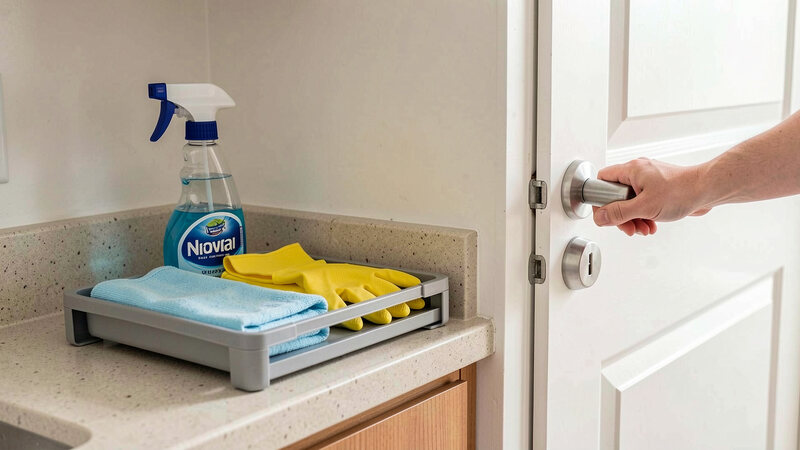
Most infections that pass through a workplace travel on hands and on the surfaces those hands touch. Cleaning high-touch surfaces is therefore one of the most useful routines a small business can keep. It is also one of the easiest to get wrong, usually by disinfecting a dirty surface or by trying to treat every surface equally. This guide covers the order of work, which points to target and how often.
Clean first, then disinfect
Cleaning removes soil: dust, grease, crumbs and fingerprints. Disinfecting reduces the germs left on the surface. If soil is still present, the disinfectant cannot reach the surface properly and works far less well. The order is therefore to clean with water or detergent first, then apply the disinfectant and let it work for the time the product specifies.
Some products combine both steps, which is convenient but easy to misuse. Even then, the surface needs to be wiped free of visible soil for the disinfecting part to do its job. Rushing the contact time is the other common error: a spray wiped off immediately has not had time to act.
List the high-touch points
You do not need to treat the whole premises the same way. Walk the space and note what many people touch in a day: door handles and push plates, handrails, light switches, lift buttons, counters, card terminals, baskets and trolleys, shared tablets, taps, toilet seats and flush handles, and the backs and arms of chairs. Add anything specific to your trade, such as a shared pen, a delivery scanner or a service bell.
Turn the walk into a short list and rank it. The points touched by the most people, or by people who then touch their face, come first. This list becomes the cleaning plan and can be reviewed whenever the layout changes.
Choose products sensibly
Two families of disinfectant cover most needs. Alcohol based products act quickly and are kind to most surfaces, but they are less effective on visibly soiled surfaces. Chlorine based products are strong and cheap but can damage metals and fabrics and need care in mixing and storage. Choose according to the surface and the level of soil, and follow the label rather than habit.
Keep one product for everyday use and a second for heavier contamination, rather than a cupboard full of half-used bottles. Store them upright, closed and away from food and from children, and keep the safety data sheets where staff can find them.
Set a realistic frequency
Twice a day, at opening and closing, is a sensible baseline for a small site, with an extra pass at the busiest time for the top few points. Toilets, handrails and door handles usually need more frequent attention than shelves or window ledges. Choosing a frequency the busiest shift can actually keep matters more than choosing an ambitious one that is abandoned within a week.
Write the frequency next to each point on the list. A simple morning, midday and evening column, with initials, makes the routine easy to run and easy to check.
Use products safely
Ventilate while cleaning, wear gloves, and avoid touching your face. Never mix different cleaning products, because some combinations release harmful gases. Label any diluted solution with its name and the date it was made, and use it within the period the maker recommends. Keep cloths for the toilet separate from those used elsewhere, and prefer disposable cloths where contamination is likely.
Keep a simple log
A log with the place, the time, the person and any note is enough. Its purpose is not inspection but spotting gaps: if the same point is missed two days running, the frequency or the assignment is wrong. Review the log weekly rather than daily, and adjust one thing at a time. Staff briefings and product safety information from public health bodies can help when the routine needs updating.
Shared equipment, phones and pens
Some of the most handled objects are the ones nobody thinks of as surfaces: card terminals, shared pens, delivery scanners, tablets, radios and staff phones. A phone that sits against a face all day is a particularly effective route for germs. Add these items to the list, wipe the shared ones at each round and encourage staff to clean their own phone once a day. A screen safe wipe avoids damage to the device.
For equipment that cannot be wiped, such as some fabric chairs or porous surfaces, use a cover that can be laundered or replaced. Check the maker's guidance before using a product on electronics, and keep a note of which cleaner suits which item so the routine does not depend on memory.
When the routine slips
Every routine slips at some point, usually during a busy spell or a staff shortage. Plan for the slip rather than pretending it will not happen. Decide which two or three points must be done even on the worst day, and let the rest wait. Protecting the most important points on a bad day keeps the routine alive, whereas an all-or-nothing approach tends to end with nothing done at all.
Start with the door
Pick the single most touched point in your premises, usually the main door handle, and make cleaning it part of opening and closing today. Then add the next few points to the list. A short routine that runs every day beats a long one that runs once.